








 Our School
 Join Our Parish
 Online Giving

When we hear the line from the first reading this weekend about not molesting or oppressing an alien, we may think of the movie E.T., in which the children help the extraterrestrial just because he needs help. What the reading calls aliens are immigrants or newcomers. They lived among the Hebrews but were not Jews themselves. The Lord reminds the people that they were once aliens themselves. They should not make the same mistake the Egyptians did when they mistreated the Israelites. God uses the same logic in commanding them to take care of widows and orphans. Treat them like family, or else your own wives and children will be in the same situation. Immigrants, widows, orphans, borrowers—all must be treated with compassion.
The reason for such compassion should be deeper than just fear of punishment. “Do to others as you would have them do to you,” Jesus said (Luke 6:31). Today’s Gospel has a similar saying: “You shall love your neighbor as yourself” (Matthew 22:39). Jesus called this the second commandment. The first is to love God wholly and completely, heart, mind, and soul. If the second commandment is the Golden Rule, the first might be called the Diamond Rule. If you think about it, in order to keep the first commandment, you have to be keeping the second as well.
Jesus said that whatever you do for the poor, the homeless, the sick, or prisoners, you do for him (Matthew 25:31–46). Mother Teresa could see Jesus in the poorest of the poor. Jesus himself showed compassion even to sinners. We can’t really say we love God if we don’t love the people God created.
So that gives us two reasons to love our neighbor. First, because God lives in other people, so loving God means loving God wherever God is found. Second, God loves them, so if we are to be holy, we must be like God. What does that mean? Remember the saying that “charity begins at home”? That is only true because it is easier to love family and friends, but charity doesn’t end there. If we truly love God, we will extend our charity to those outside our homes. People are probably still rebuilding after the earthquakes in Panama, Hurricane Isaias in the Panhandle, floods in Turkey and Nepal, and other disasters, and every city has some kind of homeless shelters. You say you love God? Let’s see you love your neighbor. -Tom Schmidt, Diocesan Publications
TREASURES FROM OUR TRADITION
There is a show on public television in which people search their attics for heirlooms, dust them off, and trek them downtown for ruthless evaluation by teams of antique experts. Occasionally the owners are surprised to learn they have been harboring priceless artifacts: a Tiffany bowl used to catch the car keys, a Van Gogh in the downstairs bathroom. What they lugged downtown in a paper bag, they carry home in bubble wrap and blankets.
It’s the same with treasures in Church life. Lots of things were lugged up into the attic years ago, and it was inevitable that some treasures would end up in the trash. Many Catholics tucked the sacrament of penance away in a dusty corner. We know it’s there if we need it, but it is not the weekly routine it once was, “whether I need it or not.” Today, especially in Lent and Advent or as part of personal preparation for marriage, ordination, or other life transitions, the sacrament of penance is a treasure of the Christian life waiting to be discovered. What’s in your attic?
—Rev. James Field, Diocesan Publications
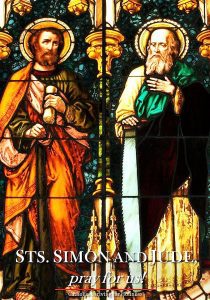 Saints Simon and Jude, Apostles – October 28
Saint Jude, apostle and . . . Hollywood success story? Indeed! Beyond Simon’s being a “ Zealot” for Israel’s liberation and Jude’s question about Jesus revealing himself (John 14:22), no historic facts are known about either saint. But Saint Jude’s well-known patronage of “lost causes” and “hopeless cases” is largely due to a desperate vow made just before World War II by a struggling entertainer, the son of Arab-American immigrants, Danny Thomas. Unemployed, his wife about to give birth, Danny, attending Mass, impulsively donated his last $7.00 to the collection, promising: “Saint Jude, if you help me find my way in life, I will build a shrine in your honor!” Older Americans remember well Danny’s long, successful movie and television career. Grateful parents worldwide know the miracles that have taken place for fifty years at his Saint Jude Children’s Research Hospital, where needy children are cared for regardless of race, religion, or financial resources, and monumental advances continue in healing and preventing pediatric cancers and catastrophic childhood diseases. A living, life-giving partnership is this “Communion of Saints”: Simon, Jude, Danny Thomas—us!
—Peter Scagnelli, Diocesan Publications