Ever notice how people today like to ignore evil in the world? People will witness a mugging and not bother to call the police. We see television stories of children starving in poor countries and say, “Not my problem.” The readings for this Sunday challenge this attitude.
As a prophet, Ezekiel is to proclaim God’s word of repentance to the wicked. The Lord tells Ezekiel that he will be held responsible for the death of the wicked if he refuses to warn against the evil they are doing.
In the Gospel, Jesus describes how his disciples should confront the sinner. His words teach us something about our duty to the sinner. First, he tells us that sin is our problem, and when we see it we need to take the initiative to stop it. Second, he tells us we need not feel alone in this duty. When the sinner refuses to listen, we bring in help. In fact, this command is meant for the whole church. Third, he tells us to be persistent; don’t give up on someone too easily.
What about that line about treating the sinner who refuses to listen as a Gentile or tax collector? On the one hand, the sinner should be excluded from the church, excommunicated, if he doesn’t repent. On the other hand, Jesus never rejected tax collectors (like Matthew himself, who wrote this Gospel) or Gentiles. He said he came to call sinners, to save them. He loves sinners. And that is the reason we are to confront them—not to punish them, but to love them. As we see in the second reading, “love is the fulfillment of the law.”
That is why the Gospel ends with Jesus’ words about disciples praying together. When we think we cannot make a sinner repent, we remember that only God can do that. We can pray for sinners, including ourselves, and ask God to renew them in the Spirit. For God never forces a person to repent. God invites with love, especially the love Jesus showed by dying on the cross. May we all learn to fight evil with love! -Tom Schmidt, Diocesan Publications
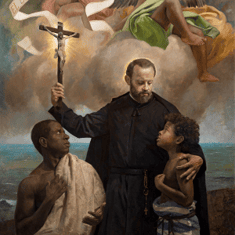 Saint Peter Claver (1581-1654) – September 9
Nearly 200 years before the Declaration of Independence proclaimed “that all men are created equal,” 250 years before the Emancipation Proclamation mandated an end to slavery, 350 years before Martin Luther King’s “I Have a Dream”, and 400 years before the election of an American president boasting African heritage, Peter Claver left his native Spain behind to volunteer for the Jesuit missions in Colombia. There, he was horrified both by slavery as an institution and by the inhuman brutality inflicted upon the slaves. He solemnly vowed to become “the slave of the slaves,” and lived that vow heroically for close to forty years. Not knowing their language, Peter began his ministry among the slaves by using the universal language of practical charity, providing medical care and a tangible though wordless assertion of their human dignity: “We spoke to them not with words but with our hands, kneeling beside them, bathing their faces and bodies, encouraging them with friendly gestures” (see Liturgy of the Hours, Volume 4, p. 2018). Then came evangelization and baptism. Holiness as human wholeness: Peter Claver’s enduring witness. -Peter Scagnelli, Diocesan Publications
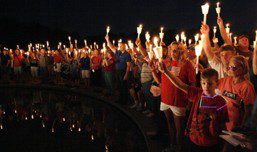 TREASURES FROM OUR TRADITION – September 11th, 2001
Our national memory will keep September 11 holy for generations to come, as we remember the innocent dead. Our memories of the attack on our nation are intertwined with memories of how we human beings are natural symbol‑ makers. In one parish, as a candlelight vigil ended, the assembly, without being instructed, took their candles and stood shoulder to shoulder, down the steps and along the city streets for a quarter mile. Slowly, people came out of their houses bearing tapers and candles. In the first hours of crisis, we stood vigil, we prayed from the heart, and we celebrated the human ability to draw light out of terrible darkness.
Stories of that terrible day necessarily drift to tales of heroism, courage, dignity, faith, solidarity, hope, community. The church learned long ago through hard experience that “the blood of the martyrs is the seed of the church.” Perhaps the victims of 9/11 have gifts to bring that we are only just discovering as believers in a just and loving God. They are teaching us still and today is a day for lighting candles at the table and being silent for a moment before the abundance of God’s gifts. Today reminds us that we are capable of acts of indescribable beauty even in the face of great evil.
-Rev. James Field, Diocesan Publications









 Our School
 Join Our Parish
 Online Giving
 St. Vincent De Paul is holding a clothing drive on September 19th and 20th. Your gently used clothes brought to Mass that weekend will be treated with the same dignity as you offer them. As you know, your donation funds the work in the community helping our neighbors in need. You may not see it, but you make a difference.